For Informational Purposes Only
Block Height of Spinal Anesthesia
Disclaimer: This article is intended solely for informational and educational purposes only. It does not constitute medical advice.
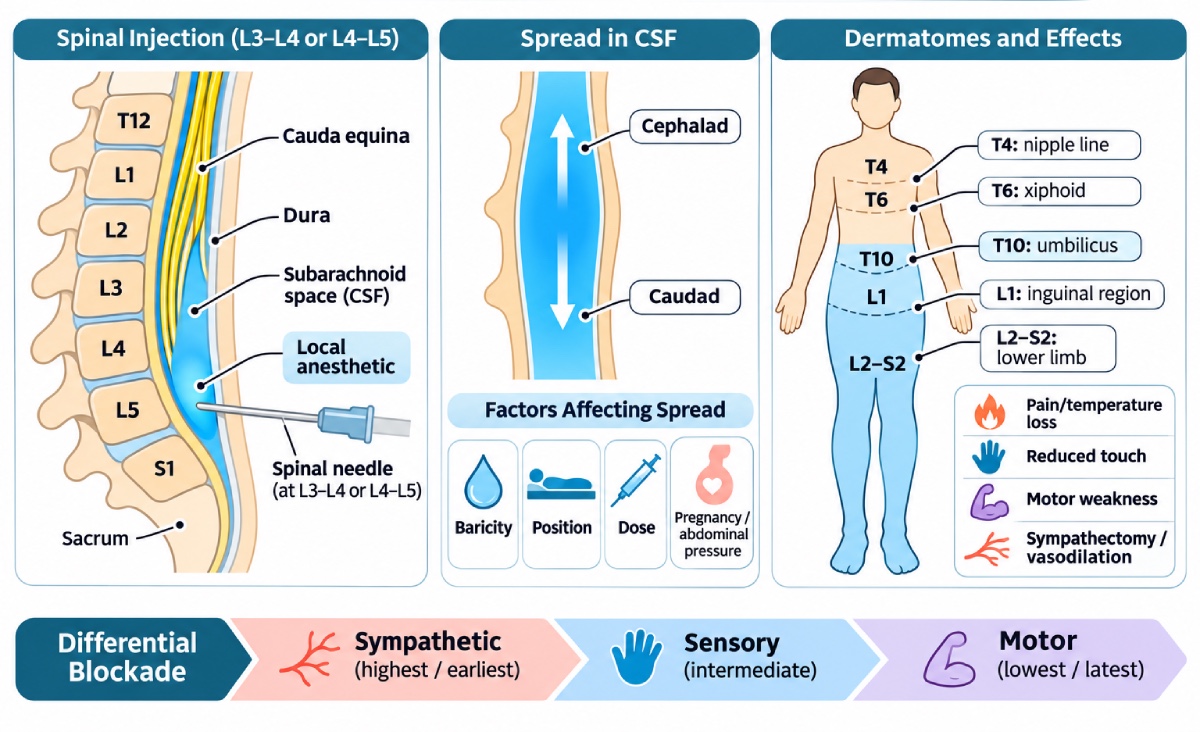
Spinal anesthesia provides nerve blockade of the lower body to the block height of the case, meaning the uppermost dermatomal level affected by intrathecal local anesthetic administration. Achieving an appropriate block height is essential for providing adequate surgical anesthesia while minimizing complications associated with excessive cephalad spread. Insufficient blockade may result in intraoperative pain or conversion to general anesthesia, whereas excessively high blockade increases the risk of hypotension, bradycardia, and respiratory compromise. Spinal anesthesia block height depends on the interaction between local anesthetic characteristics, patient anatomy, and procedural factors [1,2].
Local anesthetic dose and baricity are important determinants of intrathecal spread. Larger doses generally produce more extensive blockade, while baricity determines how the solution distributes under gravity. Hyperbaric solutions, which are denser than cerebrospinal fluid (CSF), tend to migrate toward dependent regions of the spinal canal. Consequently, patient positioning during and after injection can influence block height. Other procedural factors include injection level, concentration, volume, and speed, as well as the anesthetic solution used [1,2].
Patient characteristics also influence block height. In a retrospective study involving 401 patients, Huang and Chang identified bupivacaine dose, height, weight, sex, and age as independent predictors of peak sensory blockade. Higher doses, shorter stature, greater body weight, female sex, and advanced age were associated with greater cephalad spread. Their predictive model explained approximately 72% of the variability in block height [3].
Lumbosacral CSF volume may also be an important anatomical determinant of the block height of spinal anesthesia. In a study involving 10 healthy volunteers, Carpenter et al. demonstrated a strong inverse correlation between CSF volume and peak sensory block height. Smaller CSF volumes were associated with more extensive blockade and longer surgical anesthesia. However, CSF volume varies considerably between individuals and cannot be reliably predicted using standard measurements and technology [4].
Pregnancy presents additional considerations because physiological and anatomical changes may increase intrathecal anesthetic spread. In a randomized study involving 84 women undergoing elective cesarean delivery, Harten et al. compared fixed-dose hyperbaric bupivacaine with dosing adjusted for height and weight. High sensory blocks above T1 occurred in 17.1% of the fixed-dose group compared with 2.2% of the adjusted-dose group. Hypotension was also less frequent with adjusted dosing (50.0% versus 71.7%), although onset of anesthesia was slower [5].
Assessment of spinal anesthesia block height requires systematic evaluation of sensory and motor function. Cold sensation and pinprick are commonly used to establish the upper sensory level, although loss of cold perception generally extends higher than loss of pinprick sensation. Motor blockade can be assessed using the modified Bromage scale. Importantly, skin sensation does not fully reflect anesthesia of deeper structures, and a margin of approximately two to three dermatomes above the required surgical level is recommended during sensory assessment [6].
Excessive block height may produce extensive sympathetic blockade, resulting in hypotension, bradycardia, nausea, and vomiting. Carpenter et al. demonstrated that higher peak sensory blockade was associated with increased hypotension risk. Severe cephalad spread can additionally impair respiratory muscles and, in extreme cases, cause total spinal anesthesia requiring immediate airway and cardiovascular support [1,2].
Ultimately, successful spinal anesthesia requires balancing adequate surgical blockade against excessive physiological effects. Individualized dose selection, careful positioning, repeated sensory assessment, and vigilant hemodynamic monitoring are essential for optimizing block height and maintaining patient safety.
References
- Casey WF. Spinal anaesthesia—a practical guide. Update Anaesth. 2000;12:21–34.
- Carpenter RL, Caplan RA, Brown DL, Stephenson C, Wu R. Incidence and risk factors for side effects of spinal anesthesia. Anesthesiology. 1992;76(6):906–916.
- Huang YY, Chang KY. Sensory block level prediction of spinal anaesthesia with 0.5% hyperbaric bupivacaine: a retrospective study. Sci Rep. 2021;11:9105. doi:10.1038/s41598-021-88726-2.
- Carpenter RL, Hogan QH, Liu SS, Crane B, Moore J. Lumbosacral cerebrospinal fluid volume is the primary determinant of sensory block extent and duration during spinal anesthesia. Anesthesiology. 1998;89(1):24–29. doi:10.1097/00000542-199807000-00007.
- Harten JM, Boyne I, Hannah P, Varveris D, Brown A. Effects of a height and weight adjusted dose of local anaesthetic for spinal anaesthesia for elective Caesarean section. Anaesthesia. 2005;60(4):348–353. doi:10.1111/j.1365-2044.2005.04113.x.
- Hocking G. Assessment of spinal anaesthetic block. Update Anaesth. 2002;14:23–25.